How Often Should I Post on Instagram: The 2026 Guide
·13 min read

The popular answer to "How Often Should I Post on Instagram?" is usually "every day." That advice is easy to remember and often too blunt to be useful. A daily schedule may suit a media publisher with a production team, but it can push a solo creator or small business into rushed visuals, repetitive ideas, and an abandoned account.
The better question is: are you trying to maximize the performance of each post, or the total attention your account earns across the week? Those goals can point to different cadences. The strongest Instagram strategy is the one that matches your objective, audience, format mix, and ability to maintain quality.
Why There Is No Single Perfect Posting Number
A universal posting number doesn't exist because Instagram accounts don't operate under identical conditions. A creator with a deep content library, a product brand with user-generated content, and a consultant producing everything alone face very different capacity limits. Their audiences also respond to different formats and levels of publishing frequency.
The central trade-off is between per-post efficiency and total weekly engagement. A scarce, carefully produced post may attract stronger average engagement than a routine update. Publishing more often, however, gives the account more opportunities to reach people, earn interactions, and generate follower discovery across the week.

One independent dataset makes the contrast clear. Accounts posting less than once per week recorded 1.71% total weekly engagement, while accounts posting 7 to 14 times per week reached 9.15% total weekly engagement. Yet average engagement per post moved in the opposite direction, from 2.10% to 0.53% across those frequency ranges, according to the Instagram posting frequency study summarized by Social Tools AI.
That means "more engagement" can describe two different outcomes. You might want each individual post to work harder, or you might want the account to create more total interaction opportunities. Neither objective is automatically correct.
Match the metric to the job
Choose per-post engagement when your content is expensive to produce, your audience values curation, or your team has limited creative capacity. Choose total weekly engagement and follower growth when discovery, repeated exposure, and a larger publishing surface matter more.
The Donivo guide to social media posting frequency is useful as a broader planning reference, but Instagram decisions still need account-level judgment. Start with a sustainable baseline, then evaluate whether increasing output improves the outcome you care about.
What the 2026 Benchmark Data Actually Shows
The clearest practical takeaway from current benchmark reports is that 3 to 5 Instagram feed posts per week can be a useful middle ground. That cadence creates more opportunities for discovery than a once-or-twice-weekly schedule without making high-volume publishing the default. It also leaves room for the review, replies, and creative work that make a post useful.
Higher frequency can continue to increase an account's total reach and interaction opportunities, but the benefit is not always proportional to the added workload. The practical implication isn't that every account should publish at the highest available volume. It's that frequency can help when the source material and production system are strong enough to support it.
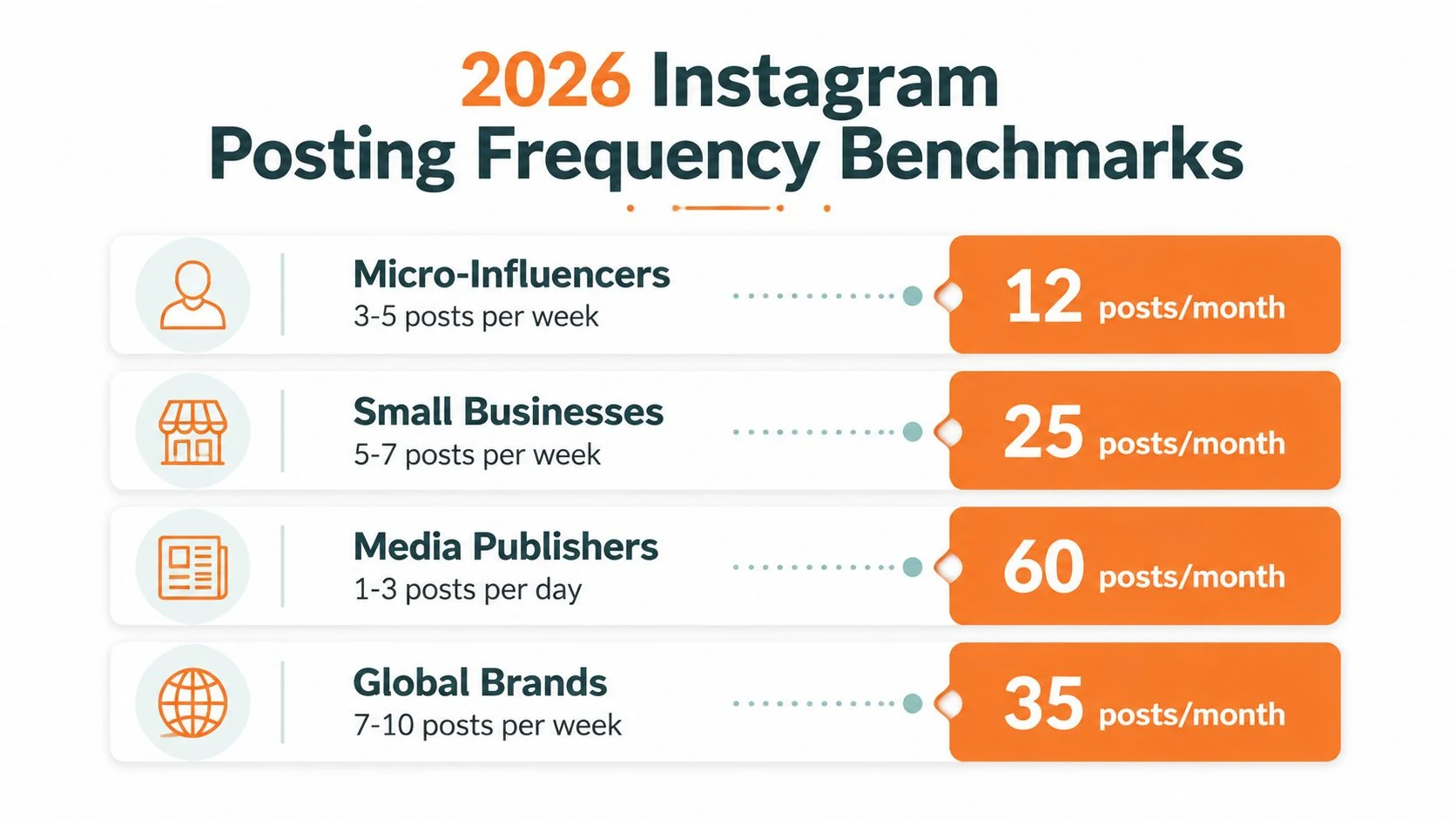
A second useful lesson from frequency research is the volume-versus-efficiency pattern. More publishing can produce more growth, but the jump in results becomes smaller relative to the added work as the schedule gets fuller. Treat the middle range as a testable starting point, not a quota.
Total engagement tells a different story
Other benchmark data points in the opposite direction when the goal is aggregate interaction. A ZoomSphere frequency analysis found that engagement rate peaked at 1 to 2 posts per week, while other large-sample findings showed total weekly engagement rising substantially at higher frequencies. Those results aren't contradictory. They measure different things.
Per-post engagement rewards selectivity. Total weekly engagement rewards additional opportunities to be seen and engaged with. A brand planning a broad awareness campaign may accept lower average interaction per post if the full week produces more activity.
Instagram also doesn't automatically downrank an account because it publishes frequently. Reporting from Social Media Today on Instagram's posting guidance explains that Instagram may place other content between posts when uploads happen too close together, but frequent publishing itself isn't an automatic penalty.
Practical rule: Increase frequency only when you can preserve useful ideas, strong creative, and sensible spacing.
Choosing a Cadence Based on Account Size and Goals
Account size affects the practical answer, but your goal determines how to use it. Larger accounts often have more content sources, clearer workflows, and enough audience activity to support a fuller calendar.
A smaller account should not copy that schedule automatically. A solo operator who can consistently produce two strong feed posts has a better foundation than one who promises daily publishing and misses half the plan. Consistency creates a dependable baseline for learning.
Compare the practical starting points
Use these as planning starting points, not promises about reach. Your production capacity and audience response should decide whether you stay at the low end, move upward, or use Stories for lighter touchpoints.
| Account type | Feed posts/week | Stories/day | Primary goal |
|---|---|---|---|
| Nano account | 2 | Flexible, based on capacity | Build a recognizable content habit |
| Small business | 3 to 5 | Regular audience touchpoints | Balance discovery and trust |
| Mid-sized account | 5 | More frequent community activity | Support growth and campaign output |
| Larger brand or team | Capacity-led | Capacity-led | Coordinate campaigns and formats |
Choose based on the constraint
Set frequency according to the result you need. If growth is the priority and you have enough useful material, begin in the 3 to 5-post range and spread those posts across the week. More publishing creates more chances to reach people, although each individual post may receive less attention.
If efficiency matters more, publish fewer, carefully edited feed posts. Use the saved time for stronger captions, community replies, and better creative. This approach can improve the return from each post without creating an unsustainable workload.
If resources are tight, do not add feed posts to match a benchmark. Use Stories for lower-production updates, questions, polls, behind-the-scenes material, and reminders. Protect the quality of the feed posts that carry your main discovery or trust-building message. Reassess after you have enough consistent output to compare total weekly engagement with engagement per post.
Distributing Your Weekly Posts Across Formats
Frequency alone won't tell you whether the schedule is well designed. Format mix determines what each publishing slot is supposed to accomplish. Socialinsider's independent Instagram benchmark report for Q2 2026 found an overall organic engagement rate of 0.45% and noted that Reels were the most frequently posted format among brands, ahead of images and carousels.
That shift matters because Instagram is no longer only a feed of static visuals. Short video has become central to how brands build reach, while carousels and images remain useful for explanation, brand presentation, and deliberate engagement.
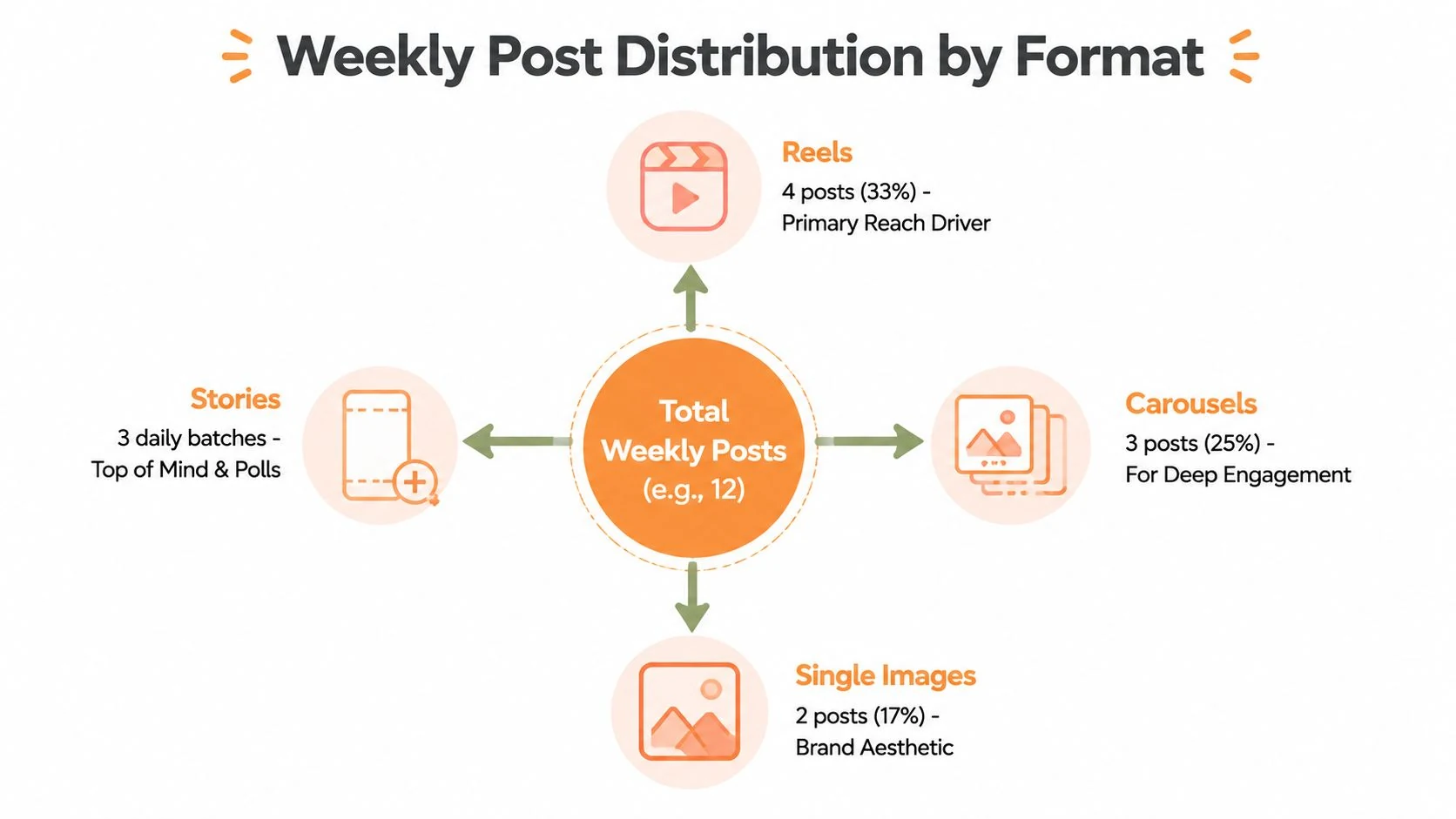
Use your chosen weekly total as a planning container rather than a demand to create every asset from scratch.
Build a balanced mix
For a moderate weekly schedule, assign the most slots to Reels if discovery is the main objective. Use carousels for tutorials, comparisons, checklists, and product education. Reserve single-image posts for announcements, visual identity, testimonials, or moments where one strong image carries the message.
A practical content loop looks like this:
- Start with one useful idea: Turn a customer question, product benefit, or recurring misconception into a clear topic.
- Adapt the idea: Make one version a Reel, another a carousel, and a shorter reminder a Story.
- Add interaction: Use Story questions, polls, replies, or link prompts to invite a response.
- Review the format separately: Compare Reels with Reels and carousels with carousels. Don't judge every format by the same performance expectation.
Stories should complement the feed, not replace it by default. They're well suited to informal updates and audience feedback because they require less polish and can keep a brand present between feed publications.
Use Donivo's Instagram best time to post tool to support timing decisions, but treat timing as an input rather than a substitute for a useful format and clear idea.
Building a Repeatable Scheduling Workflow
A cadence only works if your team can execute it without rebuilding the plan every morning. The reliable approach is to turn content production into a sequence: gather ideas, create assets in batches, adapt each asset for its intended format, schedule the queue, and verify the result after publication.
Start by defining the weekly slots before producing content. Give each slot a role, such as discovery, education, proof, community, or promotion. This prevents a calendar filled with visually different posts that all make the same request.
A workable publishing sequence
- Collect and prioritize ideas. Keep a running list of customer questions, product objections, recurring themes, and content that deserves a new treatment. Select ideas that fit the audience's current needs rather than forcing every trend into the calendar.
- Batch the production. Create several related assets in one session. Film multiple short clips while the setup is ready, or draft several carousel outlines around one topic. Batch work reduces context switching and makes the target cadence easier to maintain.
- Adapt for Instagram. Check the crop, opening frame, caption length, accessibility details, and call to action. A caption written for LinkedIn or a video created for TikTok may need substantial editing before it feels native on Instagram.
- Schedule with spacing. Use a queue or calendar to distribute feed posts across the week. Set specific times based on your audience's behavior and your own performance history, then leave enough space for comments and community management.
- Preview and verify. Review the final appearance before publishing, then check that the post went live correctly. A scheduler should be treated as an operational workflow, not merely a button that removes manual posting.
Protect the schedule from failure
Queue-based publishing helps teams keep recurring slots filled, while automatic retry and email notifications can surface failed publishes instead of leaving a gap unnoticed. Multi-workspace organization also helps agencies and marketing teams separate clients, brands, or internal projects without mixing calendars.
The Donivo guide to scheduling Instagram posts covers the planning process in more detail. Whatever tool you use, keep a human review step for time-sensitive campaigns, product details, and posts that depend on current events.
Testing and Adjusting Your Cadence Over Time
A posting schedule shouldn't become permanent because it looked sensible on paper. Treat it as a working hypothesis. Run one cadence long enough to collect a useful pattern, then compare it with a different cadence while keeping the content quality and format mix as similar as practical.
The cleanest test changes one main variable. If one period uses fewer feed posts and another uses more, don't also replace every format, change the audience, and launch a major promotion. Otherwise, you won't know whether frequency created the difference.
Track two scoreboards
Your first scoreboard measures efficiency:
- Engagement per post
- Saves and shares relative to the post
- Comments and meaningful replies
- Reach generated by each format
Your second scoreboard measures weekly output:
- Total reach across the week
- Total interactions across the week
- Net follower movement
- Number of posts published successfully
A higher posting frequency can lower average engagement per post while increasing total weekly engagement. That isn't a failed test if total interactions and growth are your primary objectives. Conversely, a lower cadence may be the right result if it protects quality and produces stronger interactions from a limited audience.
Don't ask only whether the latest post performed well. Ask whether the publishing system improved the account's weekly outcome.
Know when to change course
Increase frequency when the team has unused content capacity, quality remains stable, and weekly reach or follower growth is the objective. Hold steady when the schedule is producing useful results without straining production. Reduce frequency when rushed work, repeated topics, missed deadlines, or weak audience response indicate that volume is overtaking substance.
Format tests deserve the same discipline. Compare Reels against Reels, carousels against carousels, and promotional posts against promotional posts. Campaign periods, launches, and seasonal events can justify a temporary departure from the baseline, but document the reason so you don't mistake a short-term spike or dip for a permanent cadence lesson.
Your Action Plan for Consistent Instagram Growth
Choose your cadence by deciding what you need to optimize. If per-post efficiency matters most, begin with the smallest schedule you can maintain without lowering standards. For a solo creator or nano account, that may mean 2 feed posts per week. A team focused on broader discovery can test the 3 to 5 feed posts per week range discussed earlier.
Use this checklist to turn the choice into a working system:
- Set one primary goal, per-post efficiency or total weekly growth.
- Match feed frequency to production capacity.
- Give Reels a larger share when discovery is the priority.
- Use carousels or images for explanation, proof, and brand consistency.
- Reserve Stories for lighter touchpoints and audience feedback.
- Batch the first week of content before publishing begins.
- Review per-post and total-week results separately.
- Change frequency only when you can explain the result.
Keep evergreen ideas available for busy periods. Repurpose a strong topic into another format, but add a fresh angle rather than posting near-duplicates. A higher cadence may reduce average engagement per post while increasing total weekly reach and interactions. A lower cadence can protect quality when capacity or audience size is limited.
The target is a repeatable system, not a universal number. Donivo connects Instagram and other social accounts, lets you create image or video posts, and publishes immediately or through a queue or calendar. Visit Donivo to organize your cadence, preview scheduled content, and manage publishing tasks in one workspace.