How to Build a Social Media Content Strategy
·12 min read
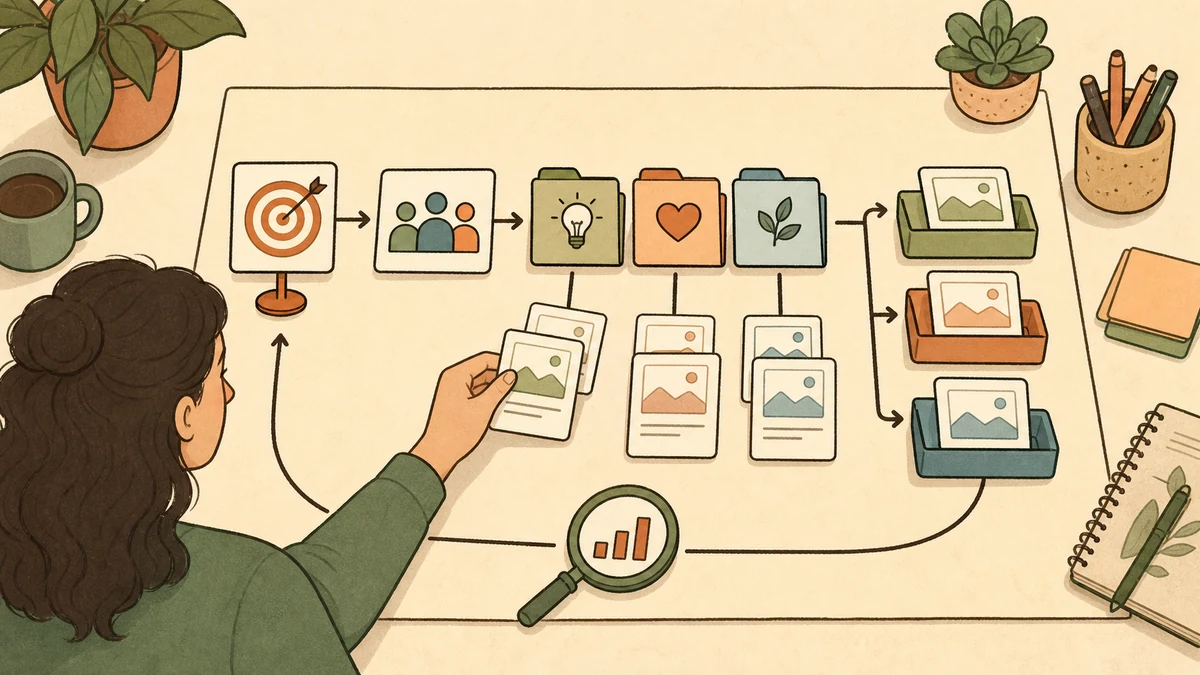
A useful strategy should make the next publishing decision easier
Document seven choices: outcome and audience, editorial promise, network roles, content pillars, adaptation rules, sustainable cadence, and the review loop. If a document cannot help you accept, reject, shape, or stop work, it is background material rather than a working strategy.
A social media content strategy is the set of choices that connects what your audience needs with what you will publish, where you will publish it, and how you will decide whether to continue. It is not a posting schedule, an idea list, or a presentation that gets opened once.
The output should be short enough to use every week. It should tell a founder or hands-on marketer which ideas fit, which networks deserve attention, how one source becomes several useful versions, what pace the team can sustain, and what evidence would justify a change.
Strategy
Content plan
Content calendar
If the direction is already clear and you need to document the production rules, use the seven-decision social media content plan. If real posts are ready for owners and dates, move them into the social media content calendar.
Build the strategy in seven decisions
Work through these choices in order. Keep each answer concise. The useful detail is the reason behind the choice and the test that tells you when it no longer holds.
Decision 1
Choose the outcome and audience
Ask
Whose situation should your content improve, and what useful change should the publishing support?
Decide
Record one audience, one practical outcome for them, and one related business outcome you can observe.
Working test
A new contributor could reject an attractive idea because it serves the wrong person or outcome.
Decision 2
Write the editorial promise
Ask
What can people reliably expect to learn, decide, or do when they follow your content?
Decide
Write a one-sentence promise that sets the topic boundary, point of view, and standard of usefulness.
Working test
The promise is specific enough to guide a post, but broad enough to support several recurring themes.
Decision 3
Give each network one job
Ask
Which destinations fit the audience, the content you can make, and the action you want people to take?
Decide
Choose only the networks you can support and assign a distinct role to each one.
Working test
You can explain why every selected network exists without saying that you need to be everywhere.
Decision 4
Select repeatable content pillars
Ask
Which themes join audience demand, business relevance, and evidence you can provide?
Decide
Choose three to five pillars and name the source material that will keep each one credible.
Working test
Each pillar can produce several useful posts and has a clear rejection boundary.
Decision 5
Set adaptation rules
Ask
What must remain true when one idea becomes several network-specific posts, and what should change?
Decide
Preserve the claim and source while allowing the hook, length, format, visual, and call to action to change.
Working test
The versions feel native to their destination without changing the meaning of the source.
Decision 6
Choose a sustainable cadence
Ask
How much source material can you create, adapt, check, publish, and review without lowering the standard?
Decide
Set a source-post rhythm first, then decide which destinations genuinely need an adapted version.
Working test
The cadence still works during an ordinary busy week, not only during a launch.
Decision 7
Build the review loop
Ask
Which signals match the intended outcome, and what decision will each signal change?
Decide
Choose a review window, record a small set of signals, and define keep, adjust, test, and stop actions.
Working test
The review produces a decision instead of a dashboard tour or a reaction to one post.
Turn the answers into a one-page strategy contract
A strategy becomes usable when its decisions are visible in one place. The contract below is not a campaign brief or content calendar. It is the stable reference that guides both.
| Layer | Record once | Use each week |
|---|---|---|
| Direction | Audience, audience outcome, business outcome, and editorial promise. | Reject ideas that do not help the intended person or support the chosen outcome. |
| Choices | Selected networks, the job of each network, content pillars, and explicit exclusions. | Choose where an idea belongs and which themes deserve production time. |
| System | Source standards, adaptation rules, source-post cadence, and publication checks. | Turn one credible idea into the right versions without changing its meaning. |
| Feedback | Review window, outcome signals, learning questions, and decision rules. | Keep, adjust, test, or stop parts of the system using patterns rather than isolated results. |
Worked example: a small design studio
This hypothetical strategy is intentionally compact. It makes enough choices to guide work without pretending to predict which individual post will perform best.
- Audience and outcome
- Homeowners planning a first renovation should understand the decisions that prevent avoidable rework.
- Business outcome
- Generate more qualified visits to the studio’s project guide and more relevant consultation requests.
- Editorial promise
- Plain-language guidance that helps homeowners prepare a better renovation brief before they hire.
- Network roles
- A professional network explains decisions in depth; a visual network shows annotated process examples and material choices.
- Content pillars
- Briefing, budgets and trade-offs, design process, and avoidable planning mistakes.
- Proof sources
- Project checklists, anonymized process examples, material specifications, and recurring client questions.
- Cadence and adaptation
- Two source explanations each week. Adapt the visual version only when a diagram, material, or before-and-after sequence makes the lesson clearer.
- Review loop
- Review tagged guide visits, useful questions, saves, and consultation quality every four weeks; keep, adjust, test, or stop one element at a time.
Make distribution and measurement part of the strategy
Publishing is not finished when the post enters a queue. Decide how a reader can take the next useful step, how the destination link will be labeled, and which signal will tell you whether that path is working. Keep the call to action proportional to the content: a definition may lead to another guide, while a decision framework may lead to a template, tool, or signup.
When a post sends people to your site, use a consistent naming convention for the source, medium, and campaign. Google Analytics documents how custom campaign parameters appear in acquisition reporting. Donivo's free UTM builder can create the tagged URL without making campaign naming a manual formatting task.
Do not confuse a measurable signal with a complete explanation. A tagged visit, signup, save, or reply can show what happened. It does not automatically explain why. Use the review to form a specific question, then test the smallest plausible change.
Use a four-action review loop
The review loop protects the strategy from two common failures: never changing anything, and changing everything too quickly. Review comparable work over the window you chose, then take one of four actions.
Keep
Use when: A theme repeatedly supports the intended audience action and remains practical to produce.
Then: Keep the strategic decision stable and make the next examples more specific.
Adjust
Use when: The topic is useful, but the hook, format, destination, or call to action creates friction.
Then: Change the smallest execution rule that can explain the pattern.
Test
Use when: You have a credible question but not enough comparable evidence to make a permanent change.
Then: Run one bounded variation while keeping the audience, promise, and source standard stable.
Stop
Use when: A pillar, network, or format repeatedly lacks audience value, credible source material, or production capacity.
Then: Remove it from the active system and record why, so it does not return by habit.
Six signs the strategy is not operational yet
The strategy is a list of post ideas.
Ideas are outputs. Add the audience outcome, editorial promise, network roles, source standards, and review rules that decide which ideas deserve work.
Every network has the same job.
Give each destination a role or remove it. Copying the same post everywhere is a distribution habit, not a channel strategy.
The pillars are product categories.
Translate internal categories into recurring audience problems, decisions, or questions you can support with proof.
Cadence is borrowed from a benchmark.
Start with source capacity and quality control. Your system should survive an ordinary week.
Measurement is a long metric list.
Keep only signals tied to the chosen outcome and name the decision each signal can change.
The whole strategy changes after one weak post.
Review patterns across comparable work, then change one decision at a time.
Put the strategy to work this week
- Complete the seven decisions in one short working session.
- Assemble the answers under the four strategy-contract layers.
- Use the contract to accept or reject the next five content ideas.
- Turn the accepted ideas into a practical content plan.
- Give ready posts owners, versions, dates, and checks in the content calendar.
- Schedule the approved versions, then return on the chosen review date to keep, adjust, test, or stop one element.
The finished strategy should feel smaller than the work it guides. Its job is not to contain every future post. Its job is to make the next good decision repeatable, carry that decision into publishing, and create a clear reason to change course when the evidence supports it.