Copy This One-Page Social Media Strategy Template
·12 min read
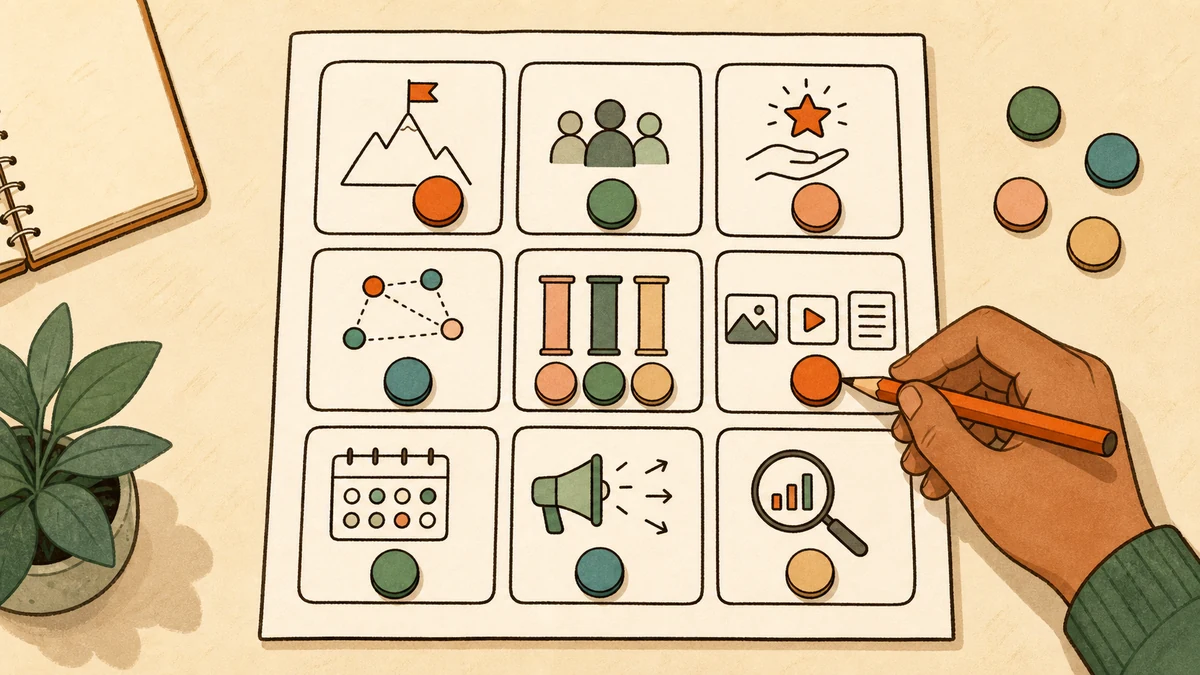
Make nine strategy decisions on one page
A social media strategy should narrow the work before a calendar fills up. This template records the audience, promise, network choices, repeatable content, distribution, and review rule in one place. Copy it, complete it in order, and use the result to reject work that does not belong.
Copy the blank template below into a document, notes app, or workspace. Keep each answer short enough to scan before you approve a post idea. The template is ungated and useful without a Donivo account.
Blank social media strategy template
Copy the plain-text version and replace every prompt with a decision.
ONE-PAGE SOCIAL MEDIA STRATEGY

1. GOAL AND REVIEW WINDOW
Business outcome social media should support:
Review date:

2. AUDIENCE AND SITUATION
Who we help:
Situation or recurring problem:
What they need from us now:

3. CONTENT PROMISE
People who follow us can expect:
Knowledge, examples, or proof we can repeatedly provide:

4. NETWORKS AND THEIR JOBS
Primary network:
Its job:
Secondary network:
Its job:
Networks we are deliberately not using:

5. CONTENT PILLARS
Pillar 1:
Pillar 2:
Pillar 3:
Optional pillar 4:
Optional pillar 5:

6. FORMATS AND ADAPTATION
Repeatable source formats:
What changes by network:
What must stay factually consistent:

7. SUSTAINABLE CADENCE
Source ideas per week:
Adapted posts per source idea:
Space reserved for timely work:

8. DISTRIBUTION AND RESPONSE
How each post will reach the right people:
Who responds to useful comments or questions:
When responses are checked:

9. REVIEW METRIC AND RULE
Primary metric:
How it will be measured:
Keep when:
Change when:
Stop when:

CALENDAR HANDOFF
First three source ideas:
1.
2.
3.
How to complete the one-page strategy
Complete the fields in order. Each choice constrains the next one. A clear audience makes the promise more specific. The promise shapes the pillars. The available source material and production capacity limit formats and cadence. The final metric checks whether the original goal is moving.
Goal and review window
What business outcome should social media support, and when will you review the strategy?
Quality check: Choose one outcome you can observe and one real review date.
Audience and situation
Who needs your help, and what situation makes your content relevant now?
Quality check: Describe a recognizable person and problem, not a broad demographic.
Content promise
What useful outcome should someone expect from following your content?
Quality check: Make a promise you can keep with knowledge, examples, or proof.
Networks and jobs
Which networks will you use, and what distinct job will each one do?
Quality check: Choose only networks you can maintain and give each a reason to exist.
Content pillars
Which three to five themes connect audience needs to what you know or can prove?
Quality check: Every pillar should support several useful posts and reject weak ideas.
Formats and adaptation
Which repeatable formats will carry the ideas, and what must change by network?
Quality check: Name the format, source material, and the hook, length, media, or context that changes.
Sustainable cadence
How many source ideas can you create, adapt, review, and publish in a normal week?
Quality check: Base the cadence on current capacity, not an ideal week or a borrowed benchmark.
Distribution and response
How will each post reach the right people, and who will handle meaningful replies?
Quality check: Choose a realistic distribution action and name an owner for response.
Review metric and rule
Which primary signal will you review, and what result would make you keep, change, or stop the strategy?
Quality check: Connect one metric to a decision instead of collecting unrelated numbers.
Strategy, content plan, or calendar?
These documents solve different problems. Keeping them separate prevents the strategy from turning into a weekly task list and stops the calendar from carrying decisions nobody has made.
| Document | Main question | Contains | Changes when |
|---|---|---|---|
| Strategy | Why are we publishing, for whom, and how will we decide if it works? | Goal, audience, promise, networks, pillars, distribution, metric | The audience, business goal, capacity, or evidence changes |
| Content plan | How will the team repeatedly turn the strategy into content? | Production rules, formats, adaptation, owners, review rhythm | The production workflow or available resources change |
| Calendar | What is being published, where, by whom, and when? | Individual ideas, assets, destinations, owners, dates, statuses | Work moves through the publishing queue |
Need the production rules next? Copy the social media content plan template. When the first ideas are ready, move them into the social media content calendar.
Filled example: a neighborhood café
This example stays specific without becoming a campaign brief. It records the choices that should guide several weeks of work, while individual post ideas remain outside the strategy.
Eight-week catering strategy
One owner, two networks, three source ideas per week
- Goal
- Increase qualified catering inquiries from nearby office managers over the next eight weeks. Review on October 12.
- Audience
- Office managers planning meetings who need dependable food for mixed dietary needs without a long ordering process.
- Promise
- Practical ideas for feeding a team well, with clear portions, ingredient notes, and examples from real orders.
- Networks
- Instagram shows the food and preparation. LinkedIn explains office-use cases and points people to the catering page.
- Pillars
- Menu decisions; dietary planning; behind the scenes; customer questions.
- Formats
- One photographed order, one short answer, and one preparation clip each week. Keep facts consistent; change the opening and level of detail by network.
- Cadence
- Three source ideas each week, adapted once when the second network needs different context.
- Distribution
- Tag a relevant neighborhood or event only when accurate, link to the catering page when useful, and have the owner check questions each weekday afternoon.
- Metric
- Qualified catering inquiries attributed to social links. Keep the strategy when inquiries are relevant, change topics when clicks arrive without inquiries, and stop formats that repeatedly produce neither.
Choose one review metric that matches the goal
The primary metric should tell you something about the goal, not merely describe activity on a network. If the goal is qualified inquiries, record inquiries. If the goal is product education, use a signal connected to that behavior, such as visits to a detailed guide or useful questions from the intended audience. Impressions can describe distribution, but they do not prove a business result by themselves.
Write the decision rule before the review
Use the format “keep when, change when, stop when.” The rule makes the review actionable and reduces the temptation to explain away every result after the fact.
When social posts link to your site, consistent campaign tags can help separate traffic by source and campaign. Google Analytics documents how UTM parameters identify referring campaigns. Donivo also provides a free UTM builder for creating consistently tagged links.
Three signs the strategy is still too vague
Every idea still fits
A strategy should reject some topics, networks, formats, and requests. If nothing is out of scope, the choices are not narrow enough.
The metric has no decision
A dashboard does not replace a review rule. Decide what evidence would make you continue, revise, or stop.
The cadence assumes a perfect week
Reduce the publishing promise until it survives ordinary workload, reviews, absences, and timely requests.
Move from strategy to scheduled work
Once the nine decisions are complete, choose three source ideas that fit the audience, promise, and pillars. Add production rules in the content plan, place the ready ideas on the calendar, and then prepare network-specific versions. The broader social media content strategy guide explains how those choices connect as a system.
The handoff is simple
Strategy chooses the work. The content plan makes it repeatable. The calendar gives it an owner and date. Complete the strategy, then put the first ready work on a calendar.