The Lean Content Creator Tool Stack
·12 min read
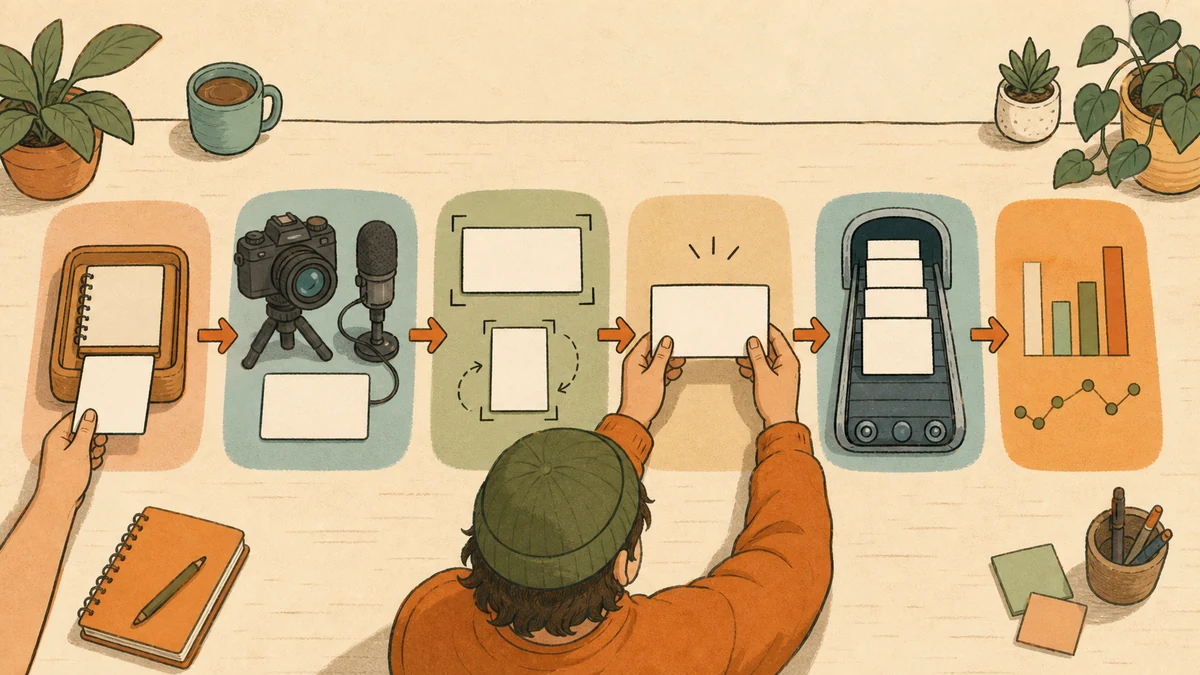
A useful content creator tool stack covers six jobs: capture, create, adapt, approve, schedule, and measure. Start with one tool for each job, reuse the same source files throughout, and pay only when a specific handoff keeps slowing down publication. Most solo creators do not need a giant list of apps. They need a small system that makes the next action obvious.
This guide gives you a free-first stack, a paid-light upgrade path, and a practical test for deciding whether any new tool deserves a place. It stays focused on the operating workflow, not an affiliate-style ranking of dozens of products.
The one-in, one-out rule
Before adding a tool, name the job it owns and the tool it replaces. If it creates another inbox, asset library, or status board without removing one, it is making your stack heavier.
Content creator tools mapped by job
The best stack is not the one with the most capable app in every row. It is the one with the cleanest handoff between rows. Use this map to assign one home to each part of the work.
| Job | Free-first setup | Paid-light upgrade | Clean handoff | Upgrade only when |
|---|---|---|---|---|
| Capture | One phone note plus the camera or recorder you already carry | A dedicated capture device or searchable idea library | Every usable idea gets a next format and status | Ideas are regularly lost or hard to retrieve |
| Create | A native or free editor for your primary format | One editor that removes a repeated production bottleneck | Export one approved master with a stable name | The current editor cannot produce a required format or quality |
| Adapt | Duplicate the master, then crop and rewrite by destination | Presets or batch tools for formats you publish every week | Keep each variant linked to the same source | Rebuilding the same variants is delaying the queue |
| Approve | A preflight checklist or comments in the source document | A review tool only when several people must sign off | One clearly marked final version leaves review | Feedback is scattered or the wrong version is published |
| Schedule | Native scheduling where it covers the complete job | A multi-platform scheduler when separate queues become repetitive | Every approved variant gets a destination and time | Copying and checking across apps is the actual bottleneck |
| Measure | Native platform analytics plus a short weekly note | Consolidated reporting when comparisons require too much manual work | Turn one observation into the next content decision | You cannot answer a recurring decision with native reports |
1. Capture: give every idea one inbox
Your capture tool should open quickly, work on the device that is already with you, and make ideas easy to retrieve. A plain notes app is enough if every idea lands there. Separate apps for voice notes, links, hooks, screenshots, and tasks become a problem when none of them is the trusted inbox.
Keep the capture record small: the idea, why it matters to the audience, the likely format, and the next action. Move source photos or recordings into the project folder as soon as the idea becomes real work. Capture is complete when the creator knows what to make next, not when the note has perfect tags.
2. Create: choose one primary production path
Pick the editor around your main source format. A video-first creator needs reliable cutting, audio, captions, and exports. A writer needs a clean drafting and revision path. A visual creator needs predictable dimensions and reusable assets. Do not buy the most advanced editor on a general “best tools” list if your actual work uses a small part of it.
Finish this stage with one master file and a stable naming pattern such as topic-source-v3-approved. The name matters less than having one obvious master. If a creator has to compare several “final” exports before adapting the post, the tool stack has already failed its first handoff.
3. Adapt: turn the master into destination-ready versions
Adaptation is more than resizing. Keep the source claim or story intact, then change the hook, crop, length, caption shape, and call to action where the destination requires it. Store the variants beside the master so an update does not leave old versions scattered across download folders.
Before adding another app, use the free tools already available in the Donivo creator toolkit. The post preview, image resizer, and character counter cover common pre-publish checks without becoming another place to manage the project.
4. Approve: keep review next to the work
A solo creator still needs approval, but it can be a short preflight: correct account, accurate claim, working link, licensed asset, correct crop, and intentional publish time. Add formal software only when another person must review the work and comments are regularly lost in messages or email.
A shared document can cover light review. Google's official Docs guidance for suggested edits explains how commenters and editors can propose changes that the owner accepts or rejects. Whatever you use, establish one visible status that means “this exact version is approved.”
5. Schedule: centralize only when separate queues hurt
Native scheduling is a reasonable free-first choice when you publish to one or two destinations and each native workflow supports the format you need. A multi-platform scheduler earns its place when the same publishing week requires repeated account switching, copying, timing, and verification.
Donivo covers the focused publishing job across Facebook, Instagram, X, YouTube, TikTok, LinkedIn, Threads, and Bluesky. You can create a post once, tailor it where needed, and schedule the destination versions from one workflow. It uses OAuth connections, retries failed publications, and alerts you when something needs attention. It does not replace your editor or provide an advanced approval chain.
Read the practical social media scheduling guide if you need to decide between native tools and one consolidated queue.
6. Measure: answer one question at a time
Start with the analytics supplied by the destination where the content lives. Record only what informs a decision: which topic earned qualified attention, which format held interest, which call to action produced the intended response, and what should be repeated or changed.
For example, YouTube's official creator measurement guidance points creators to YouTube Analytics for video and channel performance reports. Use that native evidence before paying for a separate dashboard. Upgrade only when you repeatedly need a cross-destination answer that native reports cannot provide without burdensome manual work.
The free-first content creator stack
- Capture every idea in one phone note and move real projects into one folder.
- Create the primary piece with the editor you already know or a platform-native editor.
- Duplicate the master and adapt only the versions you will actually publish.
- Approve with a checklist or comments in the source document.
- Use native scheduling while the number of destinations remains manageable.
- Review native analytics once a week and write down one decision for the next batch.
This stack costs no new subscription if you already have a phone, a usable editor, and access to the platforms where you publish. It is intentionally plain. Run one real publishing cycle before deciding that the workflow needs more software.
The paid-light upgrade path
Upgrade the bottleneck, not the whole stack. If production quality is holding you back, improve the editor or recording setup. If feedback is scattered, improve the review handoff. If repeated cross-platform publishing is the issue, add a focused scheduler. If reporting takes longer than the decision it supports, consolidate measurement.
A tool has earned an upgrade when
- The same failure appears in several cycles.
- The tool removes a complete repeated step.
- Its output moves cleanly to the next job.
- You can name the old tool or process it replaces.
Skip the upgrade when
- The problem happened once.
- The new app duplicates storage or status.
- The feature is useful only in a demo project.
- You cannot define what success would look like.
Test a creator tool with one real content cycle
- Choose one real piece. Use the video, article, episode, or post you must publish this week, not a vendor's sample project.
- Start the clock at capture. Include setup, file movement, revisions, exports, and checking. A fast feature can still create a slow workflow.
- Follow the file. Count uploads, downloads, renamed copies, pasted captions, and places where context must be recreated.
- Complete publication. Do not score the tool before the content is live and the result is verified.
- Keep or remove it. Keep the tool only if it removes the named bottleneck without creating a larger handoff elsewhere.
Build the workflow before expanding the stack
Tools cannot decide which idea matters, which claim is true, or what your audience needs next. They can make a sound creative process easier to repeat. Start by assigning one home to each of the six jobs, then document the handoffs in a simple weekly social media management workflow.
A lean stack is allowed to look boring. One trusted idea inbox, one production path, one approved master, a few deliberate variants, one publishing queue, and one weekly learning note can take a creator from thought to published work without a collection of overlapping dashboards.