How to Make a Tweet Go Viral Without Followers
·15 min read

Most advice on how to make a tweet go viral without followers starts with a better hook. That matters, but it misses the mechanical advantage that gives a new account a real chance: retweets move content through other people's networks. You don't need a large audience waiting for your post. You need a post that earns enough meaningful reactions from people who weren't following you in the first place, then a process that keeps those reactions arriving while distribution is still fresh.
The practical target isn't platform-wide fame. It's a tweet that travels far beyond your normal reach, earns reposts and substantive replies, and turns profile visits into a reason to follow. The playbook below focuses on that sequence, including what to publish, how to seed early conversation, and how to judge success without comparing a new account with an established publisher.
Why Virality Does Not Depend on Your Follower Count
A new X account does not need a large follower base to earn distribution. If every post stayed within existing followers' home timelines, reach could not expand. Retweet propagation research shows a different mechanism. People who do not follow the original author can discover and spread a tweet, then some of those viewers may follow the account. One analysis found that more than 79% of retweets were made by non-followers, while more than 50% of retweets across four domains were classified as implicit retweets. The underlying propagation summary explains how retweets, hashtags, replies, and secondary exposure carry content beyond the original follower graph.
That makes the retweet graph more important than follower accumulation at the start. Ask whether a stranger would repost the tweet because it expresses something useful, surprising, or recognizably true. An existing follower may provide the first view, but a non-follower's repost places the idea in a separate network, where another wave of replies and reposts can begin.
Practical rule: Build for the person discovering the tweet through someone else, not only for the people who already know your name.
The 2023 ACM Web Conference study on Twitter virality gives this audience-relative view a measurable basis. It found that a tweet is more likely to be classified as viral when retweets are evaluated against the author's follower count. Its best threshold was log(RT/Followers) = 0.772, equivalent to about 2,160 retweets per 1,000 followers, with a hard cutoff of 3,088 retweets. Read the study. Those absolute figures are not a target for a zero-follower account. The useful point is the ratio. A small account can reach a comparable level with far fewer raw retweets than a large account needs.
Early reply velocity determines whether that opportunity develops. A tweet that earns quick, relevant responses gives the platform more interaction to distribute, while a tweet that receives no follow-up activity has less reason to keep moving. Build your tweet explosion tactics around that mechanical sequence: make the idea clear to a stranger, give people a reason to endorse it, and support the first wave of conversation while the post is still fresh. Followers can come after the content proves it can travel.
What Viral Means for a Small Account
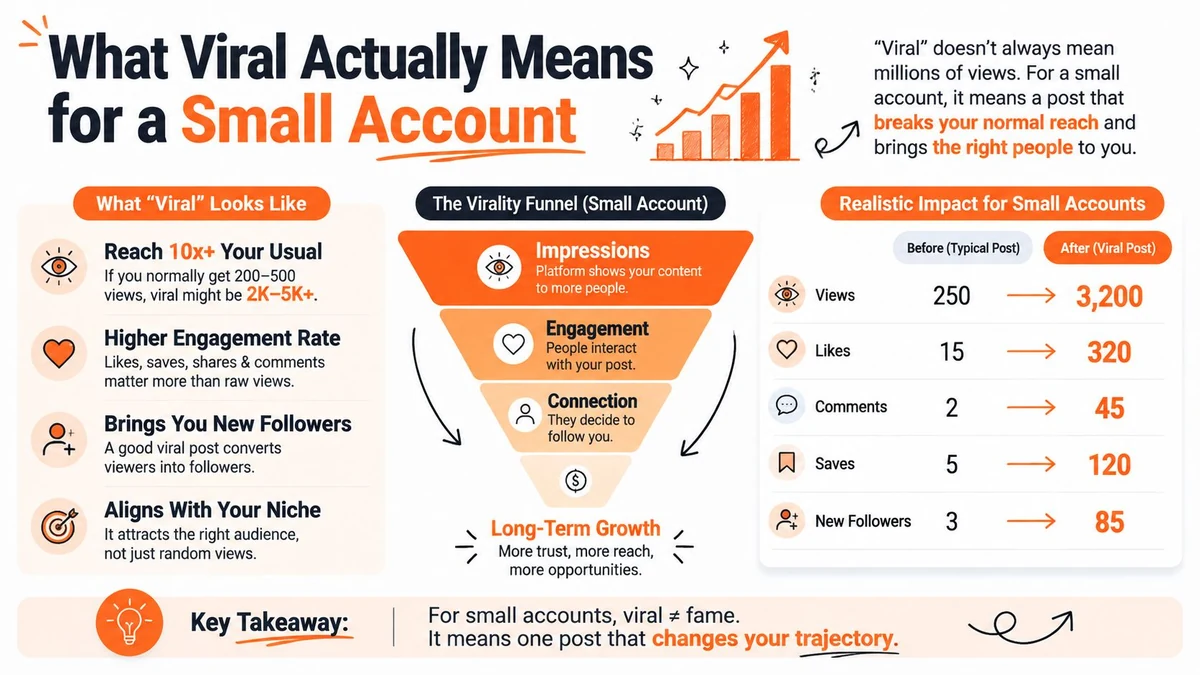
“Viral” needs a size-relative definition to guide publishing decisions. For a small account, a practical benchmark is 10 to 50 times your typical impressions, even if the post never enters a platform-wide trend. OpenTweet's 2026 guide uses this comparison because it measures distribution against the account's normal reach rather than applying a large-account standard to a new creator.
Follower-based engagement can make a successful post look weaker than it is. One 2026 benchmark summary places X's follower-based median engagement as low as 0.015%, while impression-based benchmarks are much higher. A tweet may therefore appear underwhelming when divided by followers but still receive meaningful algorithmic distribution as non-followers respond early. The benchmark analysis works best as a measurement warning, not as a guarantee of performance.
Measure the right outcome
Set your account's usual impressions as the baseline, then track actions that show whether distribution reached the right people:
- Retweet lift: Did reposts rise sharply compared with your usual posts?
- Reply depth: Did people add experiences, objections, examples, or quote-post commentary?
- Profile visits: Did unfamiliar viewers have a clear reason to investigate the account?
- Audience quality: Did those viewers belong to the niche you want to reach?
Broad impressions with few relevant profile visits may entertain people without building an audience. A narrower post that generates detailed replies from the right community can create more value for a consultant, founder, or creator.
The 2023 virality research supports this ratio-based approach by comparing retweets with follower count instead of treating raw reach as the only success measure. For a zero-follower account, record typical impressions, retweets, replies, and profile visits. Label a post viral when it materially exceeds its own baseline and produces the action that matches its purpose.
Writing Hooks That Stop the Scroll
A hook doesn't need to sound dramatic. It needs to make the reader understand the subject quickly and feel a reason to continue. X allows 280 characters for a standard post, while longer posts can reach 25,000 characters, according to X's official post-type guidance. A new account should usually treat the shorter format as a constraint that forces one clear idea, not as an invitation to squeeze several ideas into one crowded sentence.

Use a format people can repeat
Start with one of these structures, then replace the bracketed material with your own observation:
- Contrarian take: “Most advice about [topic] optimizes for [common metric]. I'd optimize for [better action] because [specific reason].”
- Numbered insight: “[Number] things I'd change after working on [specific task]: [point one].”
- Mini-case study: “I expected [outcome]. Instead, [specific observation]. The change was [lesson].”
- Useful disagreement: “I agree with [popular idea] in principle, but it fails when [condition]. Here's the adjustment.”
These patterns work because they give the reader a position, a detail, or a tension to respond to. “Post consistently and provide value” gives nobody a clear surface for agreement or disagreement. “Posting more isn't the fix when your best ideas arrive after the conversation has moved on” creates a point of view.
Native content should usually lead. A simple image paired with a concise claim, a strong opinion, or a compact explanation gives people something they can understand without leaving X. Link-heavy posts ask the platform and the reader to do more work, and independent algorithm analysis reports that external links can underperform relative to native content. The practical sequence is to publish the native idea first, invite discussion, and place a link only when it supports the conversation.
Make every thread post earn attention
A thread shouldn't hide all the value in its first post. Give each post one discrete point that could stand alone if someone encounters it through a repost. The opening can promise a useful direction, the middle can supply evidence or examples, and the close can synthesize the lesson. Before publishing, remove any sentence that exists only to connect two stronger points.
For more examples of opening structures, compare this approach with how to write hooks on X, then test your strongest drafts in a social media hooks workflow. The final check is simple: if a stranger sees only this post, will they understand the claim and know how to react?
Designing Tweets for the Algorithm
A retweet carries the idea into another person's audience, so design for reposting when distribution is the objective. One reverse-engineering analysis reported that retweets were valued at 20 times likes in its model and described recency windows of 0 to 30 minutes, 30 to 60 minutes, 1 to 2 hours, and 2 to 4 hours. Its breakdown of X ranking mechanics supports a practical rule: aim for fast, meaningful reactions, especially reposts and replies, rather than passive likes that arrive slowly.
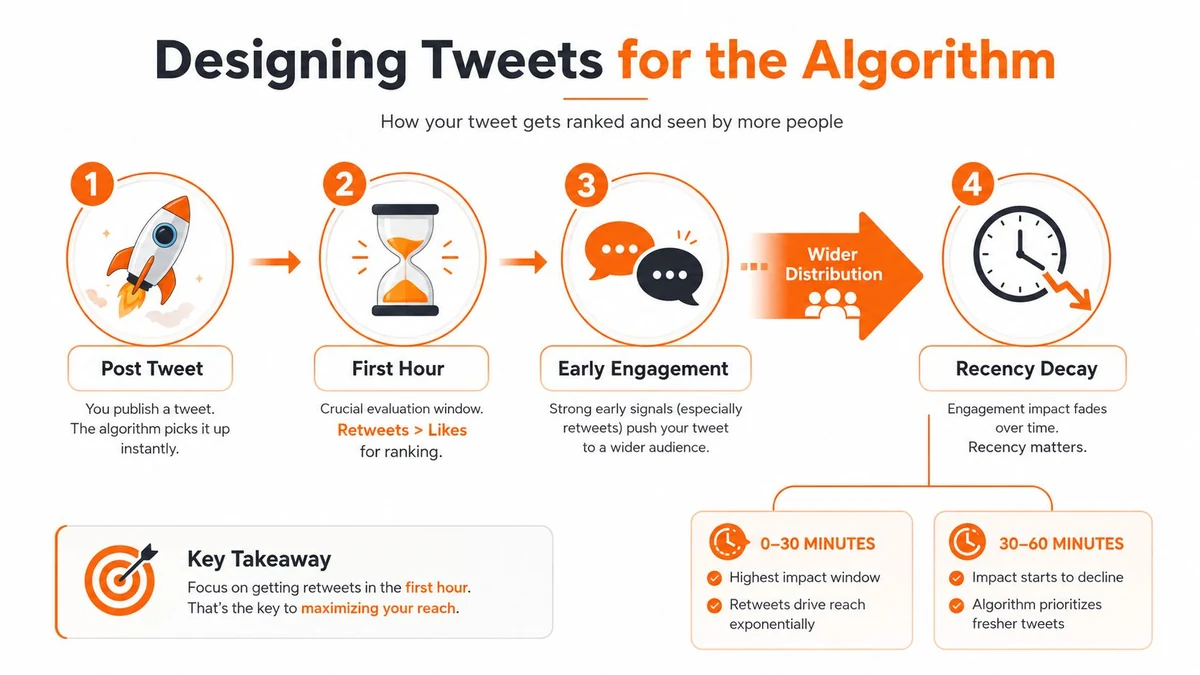
Build the first hour before you publish
Prepare the post as a small distribution system with three parts:
- The payload: Use a native image, concise claim, or strong opinion that makes sense without outside context.
- The invitation: Ask for a judgment, comparison, experience, or quote-post response. “Agree?” gives people little to add. “Which part breaks first in your workflow?” creates a more useful opening.
- The seed: Within minutes, join relevant conversations manually, share the post with interested communities, or send it to people who can contribute a substantive perspective.
The sequence matters. A post that earns an early reply can create a visible conversation, while a post that asks for an immediate click sends attention away from the native interaction loop. Let readers understand, respond, and repost the idea where they already are. Add an external destination only when it supports that discussion.
Follower-based engagement benchmarks can mislead new accounts. A zero-follower profile has no useful denominator for a traditional rate, while impression-based action rates show whether the post reached people who could respond. Use X analytics to compare retweets and replies with impressions, then review the draft in a social post preview tool before publishing.
Design the post so reposting it requires no explanation.
Timing Your Post and Building Early Reply Velocity
There isn't one universal best time to publish. A broad review found that the right posting window depends on the audience and platform context, rather than one global schedule. The review of social media timing supports testing your own audience instead of treating a generic clock as a law.
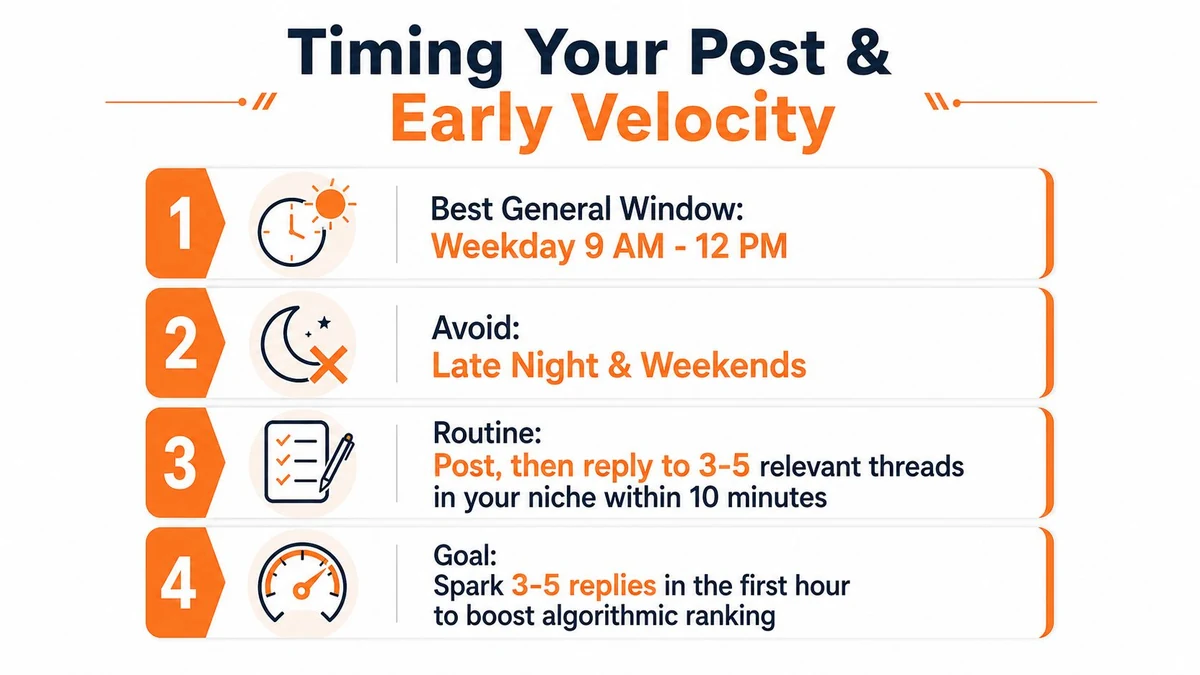
A sensible starting window is Tuesday through Thursday, from 9 a.m. to 1 p.m. in local time, based on a 2026 timing analysis summarized by industry publications. The timing overview should be treated as a starting hypothesis. Your real advantage comes from what you do immediately after publishing.
A practical first-hour routine
Before publishing, identify live conversations in your niche. Find a current topic, a large account discussing the problem, or a relevant community thread where your post would add something useful. Don't wait until the tweet is live to decide where its first viewers might come from.
Immediately after publishing, reply to relevant active threads with a real addition, not “great point” and not a pasted promotion. Quote-post a timely topic when you have a specific interpretation, and send the original post to a small group only when the subject fits their interests. Manual distribution is slower than blasting the same message everywhere, but it protects your reputation and creates better conversations.
During the first hour, answer every substantive reply and ask a follow-up when the person has offered something worth developing. That turns one response into a visible discussion rather than a row of isolated reactions. During the next few hours, keep watching the conversation and add clarification if people ask the same question.
Replies have their own mechanics. X says replies appear in the recipient's Notifications tab, and a reply can also appear in the recipient's Home timeline when the recipient follows the sender. Usernames aren't automatically placed at the beginning of a reply, so you keep the available character space unless you type the username manually. X explains replies and conversations here. Use that room for a complete thought, not a compressed compliment.
For a repeatable schedule, use a best time to post tool for X to compare your own publishing history with the general window. Timing gets the post into a live environment. Reply velocity gives people a reason to keep it moving.
Amplifying Beyond X Through Communities and Cross-Posting
A post can travel further when you adapt the idea to places where the conversation already exists. That doesn't mean dropping the same link into every community. It means finding the audience that has the problem, extracting the useful point from the X post, and contributing it in the format that community expects.
A Discord discussion may reward a short explanation and a follow-up example. LinkedIn may suit a professional lesson with context. Threads can carry a conversational version of the idea, while Instagram may need a visual card or carousel. Bluesky and Facebook can work when the topic already has an active niche discussion. The core insight stays consistent, but the opening, length, and call to respond should change.
Where one idea works hardest across networks
| Network | Best Format | Why It Helps Virality |
|---|---|---|
| X | Native claim, image, reply thread | Fast reposts and public conversation can expose the idea to non-followers |
| Practical lesson with professional context | The idea can reach people who prefer a fuller business explanation | |
| Threads | Conversational adaptation | A less formal version can invite personal responses |
| Bluesky | Niche observation or discussion prompt | Topic-focused communities can provide relevant early reactions |
| Visual summary or carousel | A visual treatment gives the idea a different discovery path | |
| Community-specific explanation | Existing groups can add context, objections, and examples |
The workflow is straightforward. Write the strongest version first, create platform-specific edits, then queue each adaptation for a suitable audience window. Keep a record of which version generated replies, reposts, saves, or profile visits. This is more useful than copying a post everywhere and calling every impression success.
A scheduler can reduce the operational risk of cross-posting by centralizing composition, platform-aware attachments, queues, and calendar slots. Donivo supports publishing and scheduling across X and other networks, with automatic retries and email notifications for failed publishes. That matters when a campaign depends on a narrow conversation window and a silent failure would otherwise go unnoticed.
For the human side of distribution, use this actionable engagement optimization as a quality check. Then adapt the workflow with cross-posting guidance, keeping the idea native to each network instead of treating every platform as a duplicate feed.
Measuring Results and Iterating on What Works
A post can look successful while producing no useful next action. For each test, record impressions, replies, reposts, profile visits, and retweets, then compare them with two baselines: the account's median results over the past seven days and its results over the past thirty days. The shorter window shows current momentum. The longer window reduces the chance that one unusual post distorts the decision.
Use the ACM ratio model cited earlier as context, not as the main score. A small account should ask whether distribution and response improved against its own recent performance. Your analytics decide what deserves another test.
Review results after the initial reply window, then again when the post has finished collecting most of its impressions. Separate early velocity from late discovery. A post that earns replies quickly may deserve a stronger opening sequence, while one that gains impressions without action needs a clearer reason to respond.
Use a keep, kill, and scale routine:
- Keep: Preserve topics and formats that beat your baseline on replies or reposts.
- Kill: Retire drafts that collect passive impressions without meaningful action.
- Scale: Create variations by changing the hook, example, or prompt.
Track the process in a spreadsheet or use an engagement rate calculator. Donivo lets you compose, preview, schedule, and manage posts across X and other networks, with queues, calendar planning, automatic retries, and email alerts for failed publishes.