Instagram Monetization Guide to Earn on Every Feature
·15 min read

You've posted consistently, watched your reach move up and down, and still can't tell which activity will produce income. One Reel attracts new viewers, a Story gets replies, and a brand asks for rates, but Instagram doesn't hand you a reliable payment for every view. That uncertainty leads many creators to chase the wrong feature.
Instagram monetization works better when you treat the platform as a deal-discovery and conversion engine, not a per-view paycheck. Reels create discovery, Stories and DMs build intent, affiliate links and product tags capture purchases, and sponsorships often provide the largest negotiated payments. A sustainable system connects those parts instead of waiting for one native payout tool to solve everything.
Why Instagram Monetization Works Differently Than You Expect
A creator can spend a week producing content, gain reach, and still earn nothing if no post leads to a commercial action. Instagram's model has developed from early video advertising experiments into a marketplace connecting creators with fans, brands, and Meta. Historical reporting summarized by Digital Applied's overview of Instagram monetization traces that shift from IGTV ads rolling out in April 2020 to later fan, brand, and platform programs. The exact mix of programs has changed over time, but the main income sources remain fans, brands, and Instagram.
The practical implication is simple. Instagram does not publish a universal per-view or per-follower creator rate. Sponsored content, affiliate commissions, Subscriptions, Gifts, Badges, and direct sales are the more workable income paths, while platform programs and eligibility rules can change. Current third-party estimates from InBeat's creator-economy benchmarks put typical Instagram rates around $25 to $150 for nano creators, $250 to $5,000 for micro creators, and $5,000 to $15,000 or more for macro creators. These figures are reference points, not guaranteed quotes. They show why a creator needs a clear offer, deliverables, usage terms, and a way to connect content with sales.
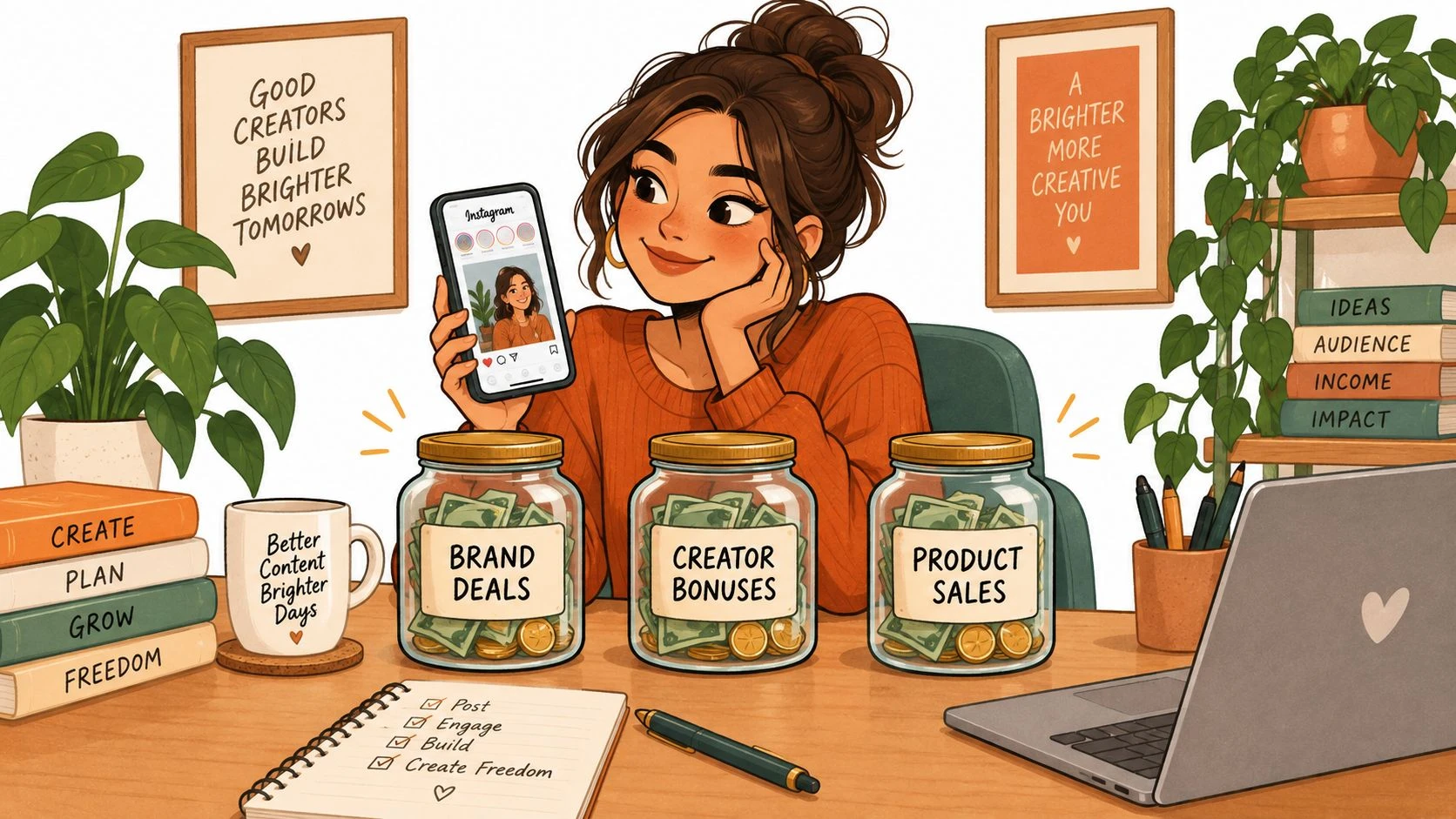
Video starts the commercial workflow
Instagram is a major advertising product for Meta. Hootsuite, citing eMarketer projections, reports that Instagram could generate about $42.52 billion in advertising revenue in 2026, compared with $22 billion in 2022. Its projected share of Meta's advertising revenue could also rise from 44% in 2022 to more than 53% by 2026. These are forecasts, not a promise about any individual account. They do show why advertisers treat Instagram inventory, particularly Reels, as a serious acquisition channel.
A useful workflow assigns each format a job. Reels create discovery. Carousels explain the product and answer objections. Stories prompt replies, polls, or link clicks. DMs, affiliate links, product tags, and brand landing pages capture intent. Donivo scheduling can keep those touchpoints consistent, while performance tracking shows which topics produce conversations or purchases rather than empty reach. If your feed is filled with irrelevant posts, use this guide to reset your Instagram feed algorithm before judging which subjects attract the audience you can serve.
Practical rule: Choose a monetization feature based on the audience's next action, not because Instagram offers it.
A smaller but responsive audience can test affiliate offers, direct sales, and straightforward brand packages before adding more complex programs. An established community may support Subscriptions, Gifts, and recurring partnerships. The useful question is not “How many views do I need?” Ask what this audience can reasonably buy, request, or support, then build the content and offer around that action.
Eligibility Checks and Account Setup Before You Can Earn
Instagram monetization starts with account status, not content volume. You can produce polished Reels and still lose time if your account, location, age, or content fails a program gate. Requirements are set per feature and can vary by country, account standing, rollout, and current terms. The current Instagram monetization requirements guide makes the same practical point: your Professional dashboard is the source of truth for the tools your account can use.
Run this pre-flight check before pitching brands or building a paid-content calendar.
Check the account foundation
Switch to a professional account if you haven't already. Instagram's creator and business account types expose professional dashboards and monetization settings that personal accounts may not show. Review the account's monetization status inside the professional dashboard rather than assuming every feature is available.
Next, inspect policy status. A Community Guidelines issue can affect account standing, while Partner Monetization Policies govern eligibility and authenticity. Content Monetization Policies apply to the material itself, so a professional account can still publish content that doesn't qualify for revenue.
Confirm the gates for paid features
Don't copy one follower threshold into your plan. Third-party summaries may quote 10,000 followers for Subscriptions or other historical thresholds, but current access is feature-, country-, and account-specific. The Instagram Subscriptions eligibility summary is useful context for professional accounts, age, terms, and payout mechanics, but verify your own dashboard before promising a paid tier. FanBell also reports that Instagram's current revenue share for Subscriptions is 0%, while app stores can collect their own fees on in-app purchases. Treat that as a current arrangement, not a permanent promise.
That doesn't mean every creator should pursue Subscriptions immediately. A recurring offer needs a reason for fans to stay, such as exclusive education, community access, behind-the-scenes material, or regular live interaction. If you can't describe the ongoing value clearly, the eligibility toggle won't solve the retention problem.
Verify content and location
Review whether your content is original, authentic, and suitable for advertisers. Avoid building a revenue plan around material that repeatedly triggers restrictions, misleading claims, reused content concerns, or unclear commercial disclosures. Confirm that the feature is available in your country and that your payout details are complete before promoting it publicly.
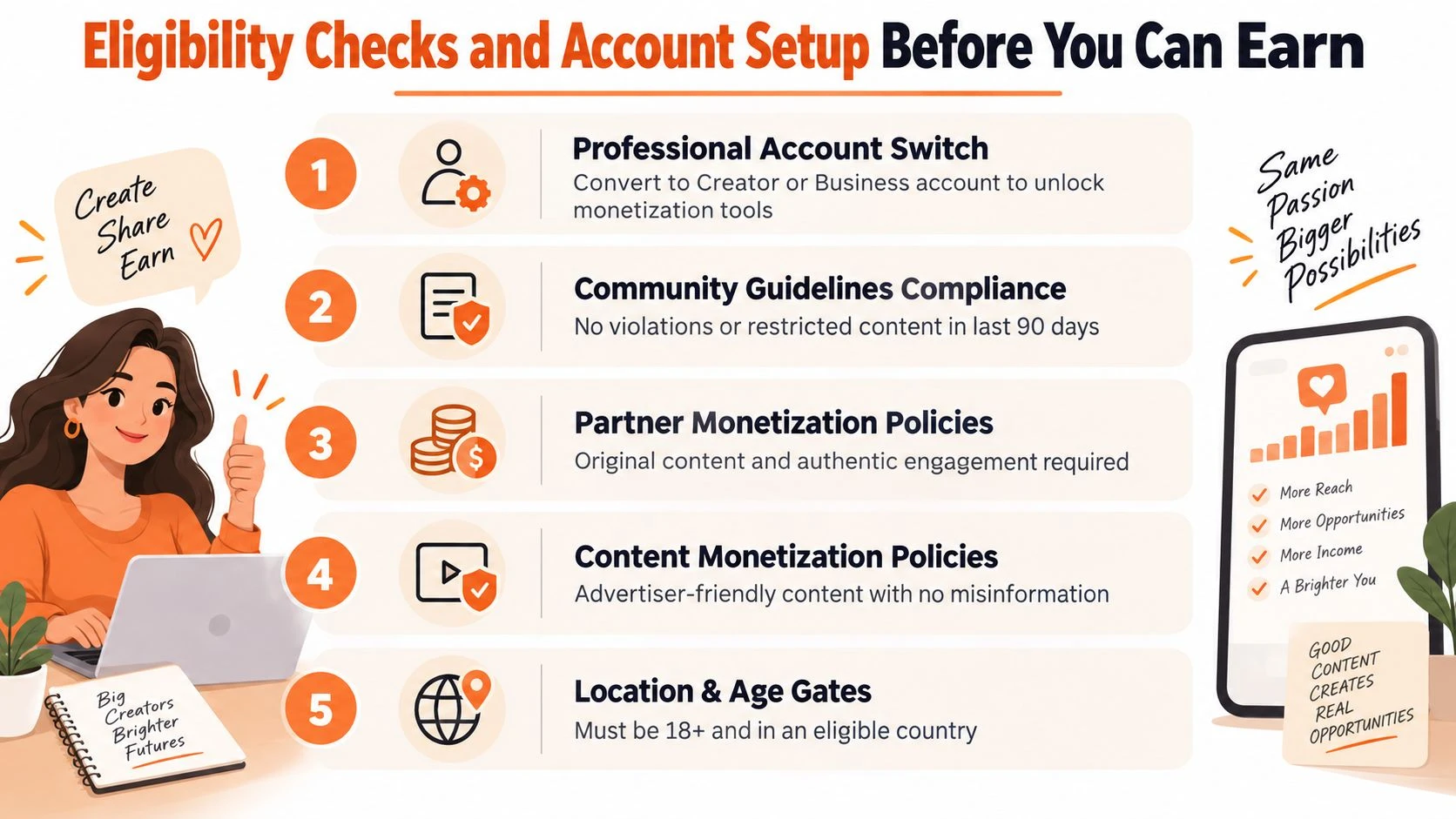
Use this checklist in order:
- Professional account: Confirm you're using a Creator or Business account.
- Policy standing: Review Community Guidelines and account status.
- Partner eligibility: Check the Partner Monetization Policies and authenticity requirements.
- Content eligibility: Confirm that individual posts meet Content Monetization Policies.
- Age and location: Verify age, country availability, and the terms for each feature.
The last step is administrative but important. Set up payment information, read the specific terms, and document which features are enabled. Native tools can be invite-only or eligibility-gated, so don't build projected income around a feature you can't activate today.
Every Way to Earn on Instagram and How to Activate Each One
Instagram offers several routes, but they don't serve the same business model. Fan payments work when the audience wants access or recognition. Affiliate links and Shops work when people are ready to buy. Brand deals work when a company wants your ability to create trusted attention and usable content.
| Pathway | Best For | Payout Source | Activation Effort |
|---|---|---|---|
| Gifts | Reels creators with active fan interaction | Stars purchased by viewers | Check eligibility, enable Gifts, publish eligible Reels |
| Subscriptions | Established communities with recurring value | Monthly fan payments | Professional account, eligibility, terms, recurring offer |
| Affiliate links | Product-led niches and smaller audiences | Commission from tracked purchases | Join relevant programs, create links, disclose clearly |
| Shops and product tags | Creators with products or supported commerce access | Product sales | Set up catalog or commerce connection, tag products |
| Brand partnerships | Creators with a clear niche and usable content | Negotiated sponsorship fee | Build media kit, pitch, negotiate deliverables |
| Direct sales | Consultants, educators, service providers, and sellers | Customer payments | Use link in bio, landing page, checkout, or DMs |
Gifts and Stars
Instagram Gifts use Stars. Viewers buy Stars and send Gifts on eligible Reels, and the creator receives $0.01 per Star under the payout explanation quoted by PetaPixel's Gifts coverage. That article also reports a $100 overall balance threshold and payment about 21 days after the end of the month in which a Gift was received. Availability, terms, thresholds, and timing can change, so check the Professional dashboard before using those figures in a forecast.
Activate the feature through the professional dashboard if it's available, then make the audience action obvious without making every Reel a solicitation. Thank supporters, create content that invites participation, and monitor the balance rather than treating Gifts as predictable salary.
Subscriptions
Subscriptions suit creators who can deliver consistent member value. Start by defining the paid promise, then check eligibility, accept the terms, choose the recurring price available to you, and design a welcome sequence. Use public content to demonstrate the transformation or access subscribers receive, but don't hide the value behind vague “exclusive content” language.
Affiliates, Shops, and product tags
Affiliate income depends on clicks and purchases, not attention alone. Choose products that fit your niche, use trackable links, disclose the commercial relationship, and connect each Reel to a clear next step. A useful resource on building that bridge is this guide to how to turn social into revenue, particularly when your audience needs education before buying.
Shops and product tags reduce friction when the product catalog and account are eligible. Tag the item in the content where you demonstrate its use, then watch product views, outbound clicks, and purchases. Don't tag unrelated products just to fill a catalog. Relevance protects trust.
Brand partnerships and direct sales
Brand deals remain the most flexible path because you can sell creative skill, audience fit, distribution, and usage rights together. Create a media kit with audience information, examples, deliverables, and starting packages. Then pitch brands whose products already appear naturally in your content.
Direct sales can be simpler than waiting for a platform program. Put a focused offer in your bio, answer buying questions in DMs, and use Stories to address objections. A service provider may need only a qualified conversation, while a product creator may need a tracked checkout flow. Study the latest Instagram Reels trends for creative formats, but keep the commercial action specific.
Content Strategy That Turns Reach Into Revenue
Reach is useful only when it moves people toward an identifiable action. Reels should usually lead discovery because the current Hubfluence 2026 influencer marketing report lists Reels at about 1.23% engagement compared with 0.48% for feed posts, with estimated CPMs of $8.50 for Reels and $12.00 for feed. The same benchmark reports 29% reach growth for Reels. These figures are industry benchmarks, not a guaranteed outcome for every account, but they support a video-first funnel.
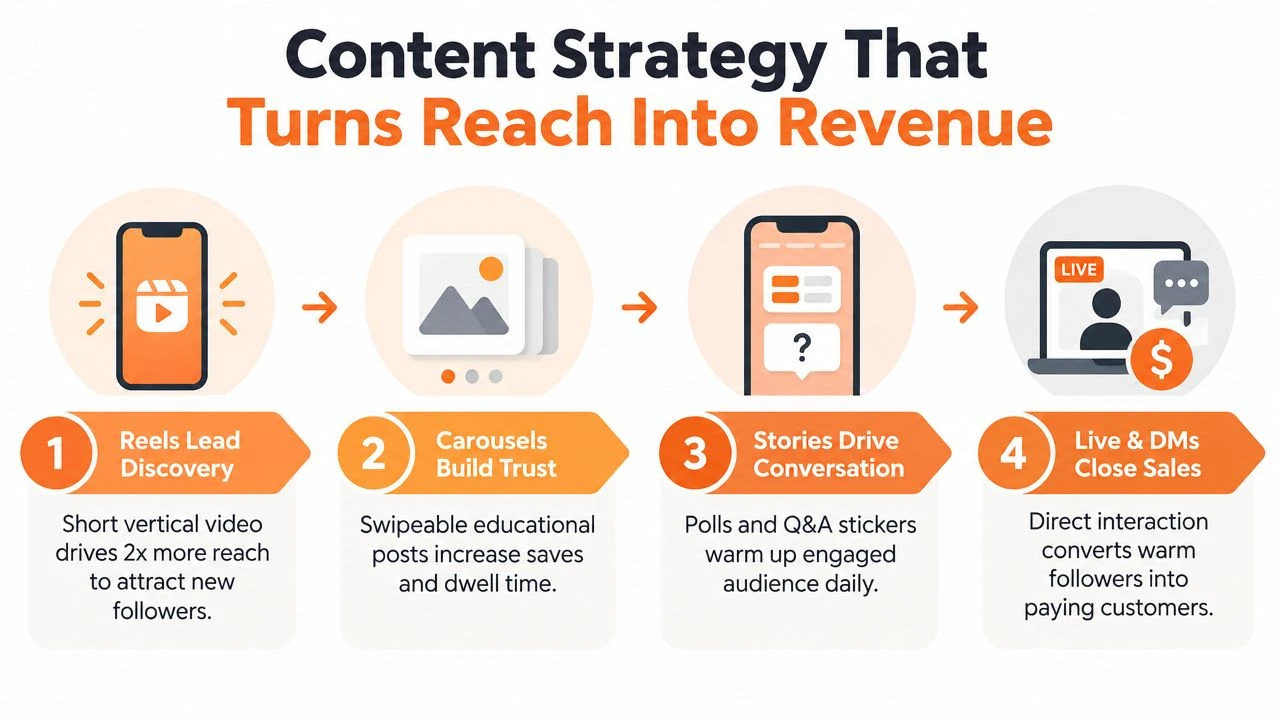
Build the funnel around intent
Use each format for a different job:
- Reels for discovery: Open with a problem, demonstration, comparison, or result. Keep the first beat understandable without context.
- Carousels for proof: Break down the method, objections, or product choices in a format people can save and revisit.
- Stories for qualification: Use polls, questions, replies, and product links to learn who's ready to act.
- DMs and live sessions for closing: Answer specific questions, recommend the right offer, and move serious prospects to checkout or a call.
A Reel about a product shouldn't end with “follow for more” if your goal is affiliate revenue. Tell viewers where to find the product, invite a keyword comment for a link, or direct them to a clearly labeled bio destination. Use UTM parameters or platform-native reporting where possible so you can distinguish views from commercial activity.
Make consistency operational
Batching helps, but batching without version control creates avoidable errors. Keep the core idea stable while adapting captions, tags, aspect ratios, disclosures, and calls to action for each network. If you're evaluating production methods, it can help to compare faceless Reel creators, especially if your niche works with screen recordings, demonstrations, voiceovers, or product close-ups rather than on-camera presentation.
Create a lightweight weekly plan with discovery topics, proof content, conversation prompts, and conversion posts. This social media content plan can help organize those roles before you start writing captions.
Conversion test: For every monetized post, name the action you want, the tracking method you'll use, and the offer that receives the traffic.
Don't judge a Reel only by views. Compare profile visits, link taps, product interactions, DMs, affiliate conversions, and qualified brand inquiries. A smaller audience that takes commercial action can be more valuable than a large audience that watches and leaves.
Pricing Your Work and Tracking What Actually Pays
A brand asks for one Reel, then requests raw footage, paid usage, exclusivity, and two rounds of revisions. A single post rate cannot cover that scope. Price the deliverable first, then list every right and extra service separately.
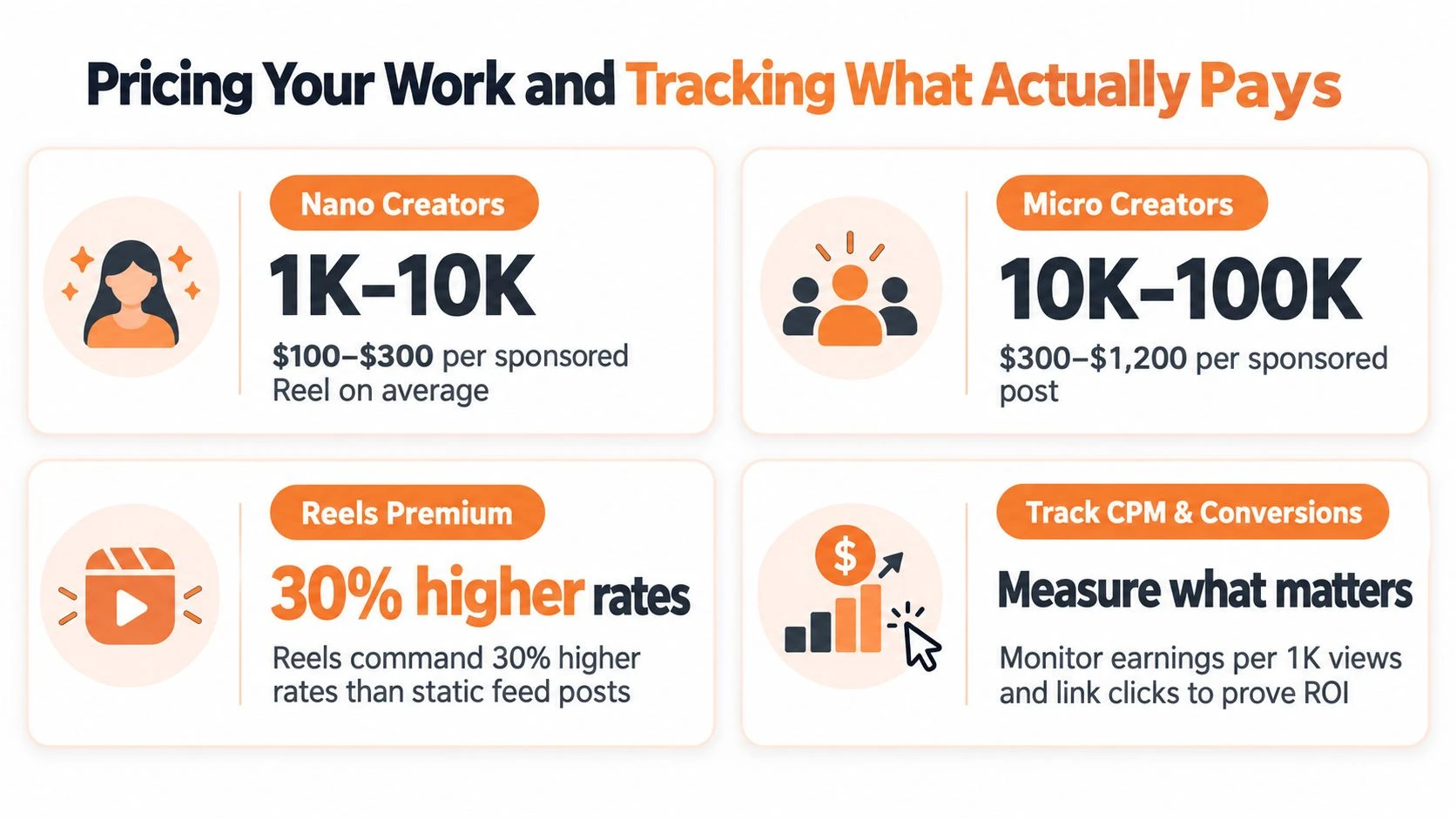
There is no official Instagram rate card. Published benchmarks diverge, so use them as negotiation context rather than a fixed price list. The current InBeat creator compensation ranges put nano Instagram creators around $25 to $150 per post, micro creators around $250 to $5,000, and macro creators around $5,000 to $15,000 or more. The Lumanu payout analysis reinforces the same caution: niche relevance, audience quality, creative complexity, exclusivity, revisions, and usage rights can change the fee substantially.
Separate the base creative fee from paid usage, whitelisting, exclusivity, extra edits, raw footage, rush delivery, and cross-platform distribution. Put the number and format of deliverables, approval process, disclosure requirements, payment schedule, and content-use period in writing.
Price the format and the outcome
Video often commands more because it requires scripting, filming, editing, and stronger commercial integration. Lumanu's analysis reported average payments of $3,618 for Reels, $1,333 for Stories, and $1,013 for posts, while Instagram represented 66.71% of creator payments and had an average payment of $1,429. Those comparisons support pricing a Reel for its production demands and business use, rather than copying a static-post fee.
Build the offer around the result the brand wants:
- Discovery package: A Reel with a clear hook, product integration, disclosure, and performance report.
- Trust package: A Reel plus carousel or Story follow-up addressing common objections.
- Conversion package: Content, link placement, DM support, and tracked reporting.
- Usage package: The same creative with separately negotiated permission for paid ads or brand channels.
Match tracking to the revenue path. Sponsored work needs reach quality, saves, replies, clicks, and the outcomes named in the brief. Affiliate work needs link clicks, conversion rate, commission, and revenue per post. Subscriptions require active members, cancellations, and recurring value. Gifts require Stars and payout balance.
Income distribution should affect your planning. Archive's creator-economy income statistics illustrate the long-tail pattern: many creators earn modest amounts while a smaller group captures much larger brand budgets. Treat any distribution statistic as survey-specific and dated, not as a forecast for your account. Follower growth alone does not guarantee better income. Use the Donivo engagement rate calculator with click and sales data to show why a focused audience can support a serious offer.
Build a Sustainable Publishing and Income Workflow
A workable system turns content into a weekly production line without making every day feel like launch day. Start by choosing a small set of commercial themes, batch the raw footage, and assign each idea a role: discovery, trust, conversation, or conversion. Write the CTA and tracking destination before you edit the video, not after it's already scheduled.
Use a central calendar to keep captions, media, disclosures, product links, and brand deliverables aligned. A platform such as Donivo supports connected Instagram publishing, immediate posting, scheduled posts, queue and calendar planning, platform-aware media handling, automatic retries, and email notifications when a publish fails. The practical sequence is connect, create, schedule, then verify the live post.
This social media management workflow is useful when several networks or brand deadlines compete for attention. Keep a maintenance checklist:
- Review payouts: Compare native earnings, affiliate commissions, and sponsorship invoices.
- Refresh the media kit: Replace weak examples with content that demonstrates commercial usefulness.
- Audit links: Test bio destinations, product tags, UTMs, and DM responses.
- Study formats: Identify which Reels, carousels, and Stories generated meaningful actions.
- Plan the next batch: Reuse proven angles while changing the example, hook, or offer.
Don't chase every feature. Choose two or three income paths that fit your audience, publish consistently, and improve the handoff from attention to action.
Use Donivo to connect your Instagram account, tailor content, and schedule a reliable publishing queue across your social workflow. Set up next week's Reels, conversion posts, and follow-up Stories in one calendar, then spend your time improving the offer and tracking what pays.